

In short
- Goalkeeper, keeper and goalie are the same position; in Spanish it's portero or arquero, depending on the country.
- Specialist goalkeeper training works on technique (catching, diving, crosses, one-on-ones, distribution), decision-making and physical and mental preparation.
- It works best in small groups of similar level, with a specialist goalkeeper coach.
- What is trained in isolation must then appear in match situations.
01Goalkeeper, keeper or goalie?
It's the same position with different names. In English you'll hear goalkeeper, keeper or, in the US and Canada, goalie. In Spanish it's portero in Spain, Mexico and Central America, and arquero in Argentina, Uruguay, Chile, Colombia or Peru.
The word changes, the job doesn't. In this guide we say “goalkeeper” for everyone, boys and girls alike.
02Why goalkeepers need their own training
It's the most specialised position in football: the only player who can use their hands, the last line of defence and, more and more, the first line of attack. Their mistakes almost always end in a goal, and their skills (catching, diving, punching clear, coming for a cross) are barely worked on in normal team training, where the goalkeeper often just faces shots.
That's why goalkeeper academies train the position separately, in small groups, and then bring that work into match situations. In Spain this is called tecnificación de porteros: improving a goalkeeper's individual technique with a specialist coach.
03What is trained: goalkeeping technique
These are the technical areas any good goalkeeper programme covers. They aren't all trained at once: each session focuses on one or two.
- Set position
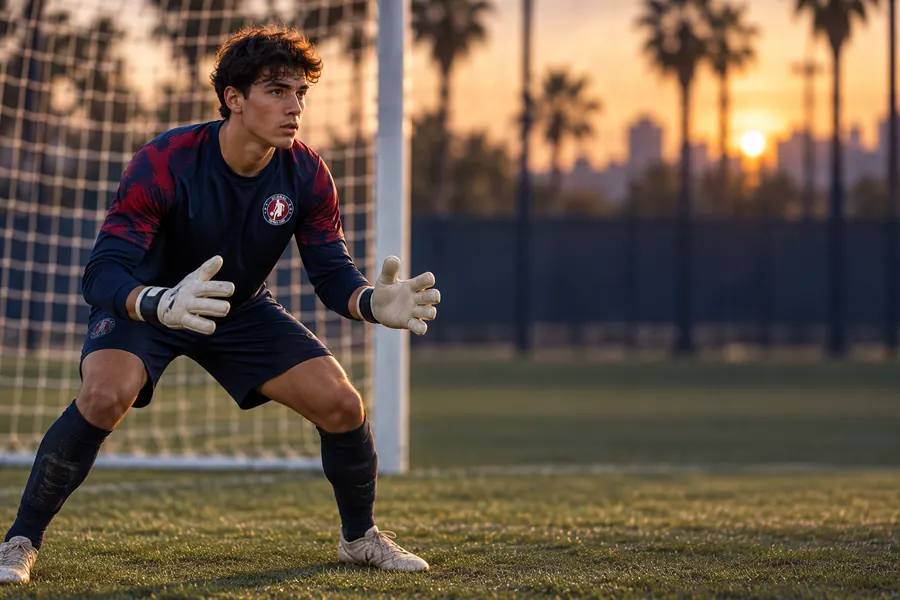
- Feet shoulder-width apart, knees bent, weight forward and hands ready. It's the base for reacting in time to any shot.
- Catching
- Catching the ball and securing it against the body, along the ground, at mid-height and overhead. A ball held cleanly gives the opponent no second chance.
- Diving
- Technique for diving to either side without getting hurt, reaching further and getting up quickly.
- Parrying and punching
- When the ball can't be held, sending it away from goal with the hands or fists.
- Crosses and high balls
- Reading crosses, choosing when to come, attacking the ball at its highest point and calling to the defence.
- One-on-ones
- Closing down the attacker to narrow the shooting angle, staying on your feet as long as possible and choosing when to go down.
- Positioning
- Taking up a position relative to the ball and the goal to cover as much of the goal as possible. The diagram below explains it.
- Footwork and distribution
- Controlling, passing and distributing with hands and feet. The modern goalkeeper also starts their team's attacks.
- Communication
- Talking to the defence, organising it and giving the team confidence.
04Beyond technique
A goalkeeper is more than a set of techniques. Good goalkeeper training also works on three things:
- Decision-making. Reading the play earlier, choosing between catching and parrying, coming out or staying. That's why technique is combined with real match actions, where the keeper has to decide as well as execute.
- Physical work. Agility, reaction speed, coordination and explosive power, adapted to age to perform better and prevent injuries.
- The mental side. Concentration for the whole match, confidence and handling mistakes so as to stay focused after an error.
05What a goalkeeper training session looks like
Every coach has their own way of working, but a session usually follows this order:
- Warm-up. Mobility, coordination and first touches of the ball.
- Technical block. Repetitions of one or two techniques, with the coach correcting every attempt.
- Real match actions. The technique appears in match situations: shots after a pass, crosses, one-on-ones.
- Cool-down. Stretching and a review of the session.
For it to work, each goalkeeper needs plenty of repetitions and corrections. That's why groups are small, with keepers of similar age and level.
06What to work on at each age
This is a general guide: every goalkeeper progresses at their own pace.
- Up to age 11
- Coordination, fun and the basics: set position, catching and diving from low positions. Many coaches recommend that at this age they also play outfield.
- Ages 12 to 15
- Refining technique, starting work on crosses and coming off the line, and improving positioning and footwork.
- From age 16
- Specialisation, position-specific physical work, reading the game and match performance.
07What to look for in a goalkeeper academy
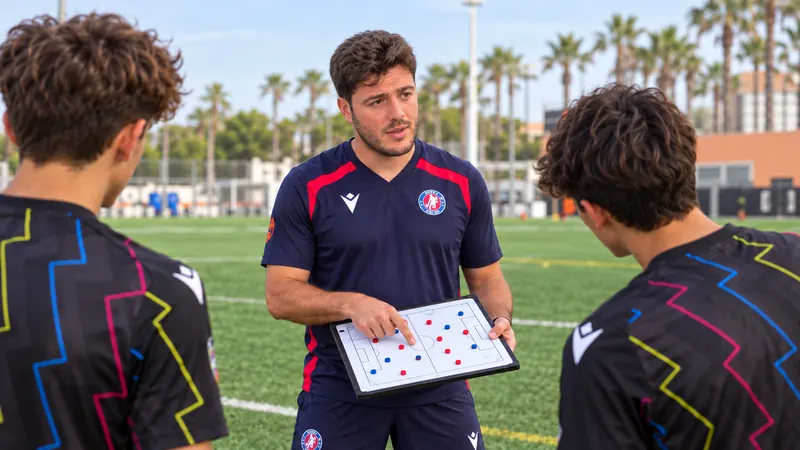
- Specialist goalkeeper coaches, not just outfield coaches.
- Small groups of similar level: more repetitions and corrections for each goalkeeper.
- Technique and match situations: isolated techniques only help if they then show up in the game.
- Clear progression, with goals for every session.
- The goalkeeper should keep training and playing with their team.
08Frequently asked questions
At what age should a child start goalkeeper training?
There's no fixed age. Many children go in goal very early. Up to age 10 or 11, what matters is that they enjoy it, build coordination and learn the basics while still playing outfield; from then on, specialist training makes more of a difference.
What equipment does a goalkeeper need?
Gloves in the right size, comfortable clothing (ideally with elbow and knee padding on hard surfaces) and boots suited to the pitch they play on.
Do girls train the same way?
Yes. The content is the same and is adapted to each goalkeeper's age and level, just as with boys.
Is specialist training the same as training with the team?
No. With the team, the goalkeeper trains the collective game; in specialist training they work on individual technique with a specialist coach. Ideally, combine both.