

In short
- It isn't a single method but a way of understanding training shared by many Spanish academies.
- The ball is in almost everything: rondos, small-sided games and conditioned matches.
- Deciding well matters as much as executing well, so training takes place in match-like situations.
- Technique is worked on individually, and values are part of training.
01What Spanish football methodology is
There's no official manual by that name. We talk about the Spanish methodology to describe a way of training shared by many academies in Spain, which has taken shape over recent decades around one central idea: players learn by playing, with the ball and making decisions.
Spain's results explain part of the interest it attracts: the men's national team won the European Championship in 2008, 2012 and 2024 and the World Cup in 2010, and the women's team won the World Cup in 2023.
02Five defining features
1. The ball at the centre
Almost every drill uses the ball. Players touch it more often and learn technique in the same context in which they'll use it in a match.
2. Rondos and small-sided games
Small spaces and few players: lots of touches, little time to think and constant decisions. The best-known drill is the rondo, in which a group passes the ball around a circle while one or two players try to win it.
3. Decide before you execute
Every action has three moments: perceiving what is happening, deciding what to do and executing it. Instead of training only the last one, all three are trained together in match-like situations.
4. Positional play
Occupying space well, creating numerical superiority and finding the free teammate. Tactical principles, in attack and defence, are taught from the youngest ages, not only to older players.
5. A coach who asks questions
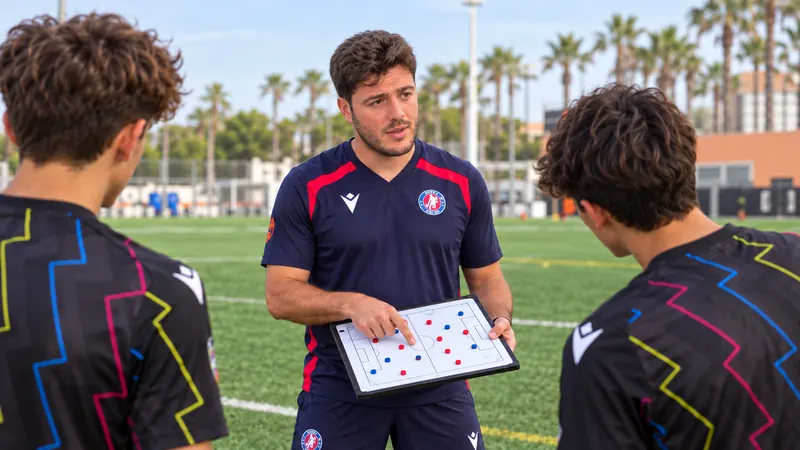
Less talking, more playing. The coach explains and demonstrates before starting, lets the drill run without stopping it and asks questions so players think for themselves.
03What a session looks like
Every club has its own style, but a session with this methodology usually looks like this:
- Warm-up with the ball. Rondos or short possession games to start thinking from the first minute.
- Technical drill. One specific technical skill, adapted to what each player needs.
- Small-sided game with a goal. For example, playing out from the back or attacking with an extra player.
- Conditioned match. A match whose rules make players use what they've trained.
- Cool-down and reflection. What went well and what needs to improve.
04What it offers a player from abroad
For many players arriving from other countries, the biggest change is the pace of decisions: you have to think faster and with less space. After a few weeks, players see more options, play with fewer touches and understand the game better.
That's why the International Team is an intensive programme to understand and adapt to the Spanish methodology, in a team with players from different countries.
05How we apply it at Global
At Global Football Total we work on each of the player's abilities (skill, agility, technique and vision) with a 100% Spanish football methodology built on three pillars: technique, tactics and values. Our coaches hold UEFA licences and follow ten rules in every session, such as “ask to teach, listen to learn” and “don't stop the drills: let them play”.
06Frequently asked questions
What is a rondo?
A drill in which several players, arranged in a circle or a square, pass the ball while one or two players in the middle try to win it. It trains passing, control, body position and decision-making under time pressure.
Does it work for every position?
Yes. Defenders, midfielders and forwards all need to perceive, decide and execute. Goalkeepers also have their own specialist training: we explain it in the guide Goalkeeper training: what a specialist programme covers.
Do I need to speak Spanish?
Not to start with. At Global Football Total we speak English and Spanish, and the Campus Global Inter FC is taught in English.
At what age can a player start?
The principles are adapted to every age. At Global there are programmes from age 6 (Player Experience and Player Test) up to 21 (Pro Player Program).